
It’s a public holiday today: Labour Day.
First celebrated on 28 October 1890 as a Trade Union led, nationwide collection of parades to pressurise the government into passing a law restricting the hours of work to eight per day, it marked fifty years since the carpenter Samuel Parnell arrived in Wellington. The October date chosen to commemorate a group of Wellington workmen meeting to set the hours of work to be 8am to 5pm. Apparently, if you didn’t tow the line, they’d dunked you in the harbour!
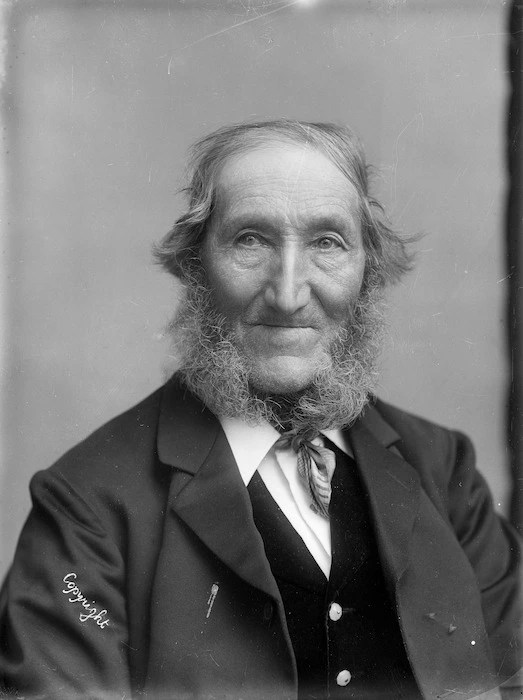
(Wright, Henry Charles Clarke, 1844-1936 :Negatives. Ref: 1/1-020462-G. Alexander Turnbull Library, Wellington, New Zealand.)
You can bet Samuel Parnell was front and centre at that meeting as, even before he’d set foot on dry land in his new home, he’d worked out he was in a position to effect change for what became known as tradesmen. The new settlement had very few men skilled in building and George Hunter, a fellow passenger pretty eager to get his business up and running asap, needed a store built. So eager was he that when Samuel happily agreed, with the rider:
I will do my best, but I must make this condition, Mr. Hunter, that on the job the hours shall only be eight for the day ... There are twenty-four hours per day given us; eight of these should be for work, eight for sleep, and the remaining eight for recreation and in which for men to do what little things they want for themselves. I am ready to start to-morrow morning at eight o'clock, but it must be on these terms or none at all.
he grudgingly agreed. Well, he did point out that in London this would not cut the mustard to which Samuel reportedly scoffed, “Yeah, well, we’re not in London now.” I might have paraphrased that last bit.
The eight hour day was never actually passed into law; it just generally became accepted as the norm until the Industrial Conciliation and Arbitration Amendment Act 1936 made the 40 hour week standard for all except shop workers who still had to work half day Saturday until 1945.
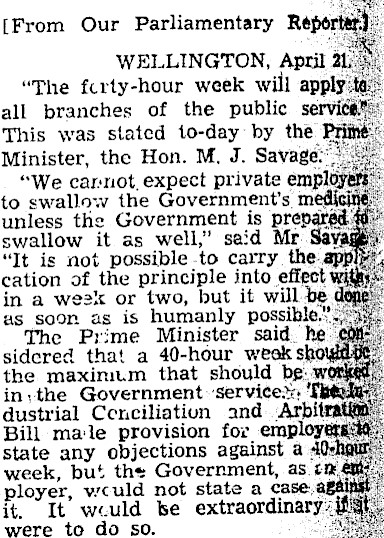
When I was young, New Zealand closed at 9pm on Friday (oh the stories: late night shopping Friday, catching the bus into Cathedral Square to wander round the shops with absolutely no intention of purchasing anything, finishing with a “cappuccino” (essentially filter coffee topped with whipped cream) brought with your hard earned babysitting dollars at “coffee lounges” like Leo’s or The Albatross, and ending with a mad sprint across the Square to make the 9.10 bus) and didn’t open again until Monday morning. The suburb of New Brighton was the exception to the rule; the only shopping centre in Christchurch allowed to open on Saturdays. Visitors to New Zealand could be quite rude about our weekends so we felt honour bound to explain ourselves such as the following excerpt from a 1950 handbook for European immigrants:
‘to the Continental European our Sundays usually appear to be very dull, because no entertainment of any kind is available on that day and normally every week-day activity closes down. Not all New Zealanders agree with this state of affairs, but most of us feel that the old tradition of keeping one day in the week for religious worship and quiet family reunion, is preferable to any other. You must make the best of these things and try not to pass judgment until you understand why they are so.’
All that changed in 1980 with the Shop Trading Hours Amendment Act 1980 allowing Saturday trading, then in 1989 Sunday trading. Through it all, Labour Day continues to be celebrated but the ethos has changed a little. Now it’s a public holiday to commemorate the history that brought into being fair working hours and also celebrate the legislating of fair compensation for work undertaken.
But for most – even The Bean Counter this time – it’s a day off.

 Union Homestead
Canadian Labour Day is the first Monday in September(same as the US), and is seen by most of us as the unofficial end to summer, as the school year begins the next day. I had to look it up because I didn’t know, but Labour Day here has been a statutory holiday since 1894, although there had been celebrations and demonstrations around labour and unions for decades prior. In 1872 there was a massive demonstration to support the typographers union, and the Trade Union Act was born. In 1882 there was a massive labour parade in Toronto, and an American labour leader who was present instigated a similar parade in New York. Shortly after, labour leaders in both countries began coordinating demonstrations, rallies, etc on the first Monday in September, et voila, we have the national holiday on the same day in both countries.
I had always wondered why both countries shared the same holiday. That makes sense.
Also, I should add that Mr Parnell put NZ on the map with his advocacy for the 8 hr work day. Years and years ahead of the rest of the world.
I think it all comes back to the “we’re not in London now” sentiment. We’re a long way from the perceived norm.
Interesting history, thank you. I have a soft spot for Sundays, as even in this 24/7 world we live in, there are very few lorries on the road, which makes it safer for elderly cyclists.
I’m with you, but the world wants 24/7